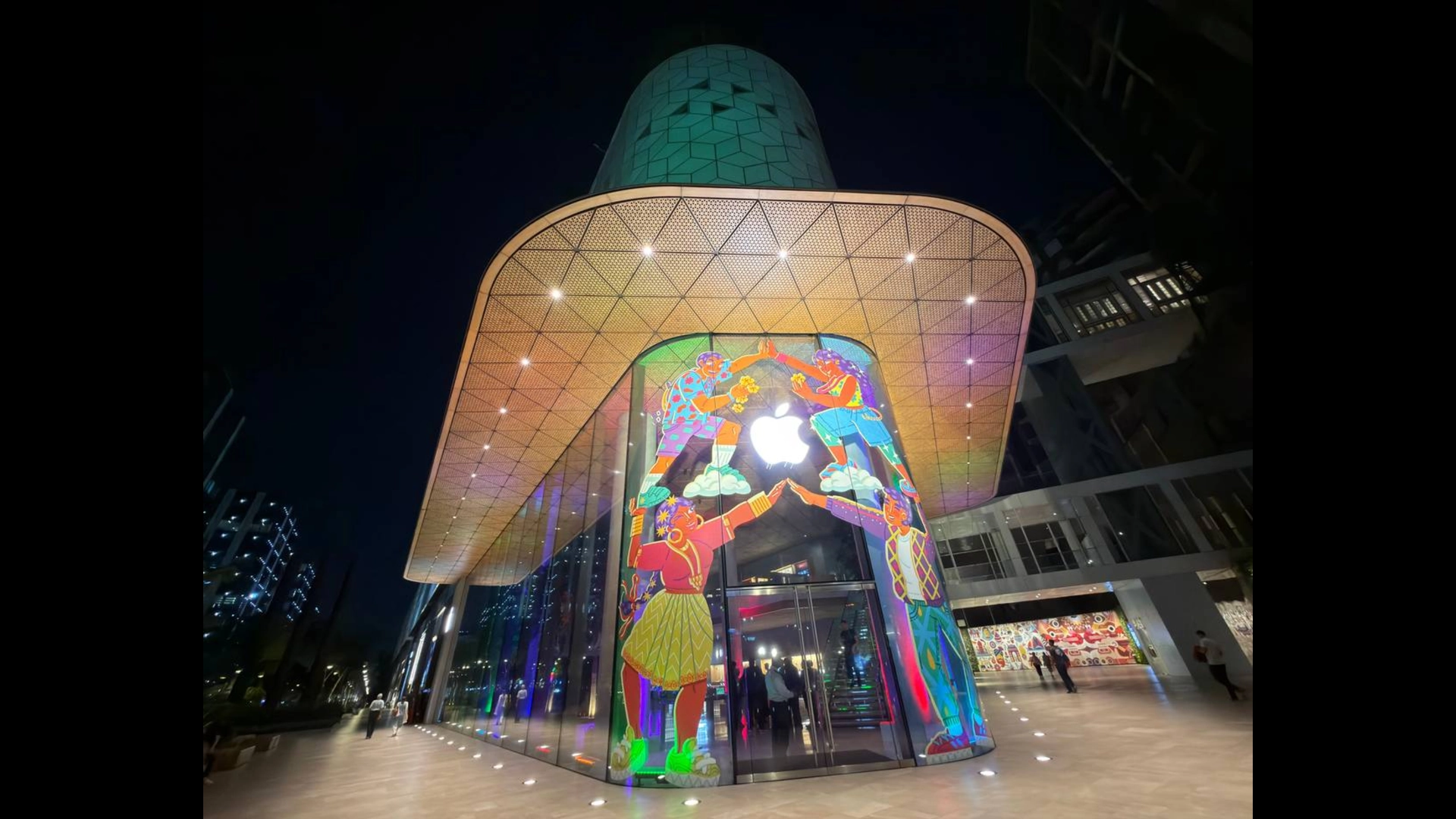
Mumbai witnessed a unique blend of technology, art and human expression as Apple marked its 50th anniversary with a special evening at its flagship store in Bandra Kurla Complex. The event brought together artist Mira Malhotra, musician Anuv Jain and actor Rohit Saraf, highlighting how creativity continues to define the company’s legacy even after five decades.
From its founding in 1976 to becoming one of the world’s most influential technology companies, Apple has consistently positioned itself not merely as a maker of devices, but as a platform for creators. The celebration at Apple BKC reflected that philosophy, placing community, storytelling and human connection at the forefront.
A Living Canvas of Community and Culture
At the heart of the celebration was a striking mural by Mumbai based artist Mira Malhotra, created specifically for the occasion. Designed using Apple tools including iPad Pro, Apple Pencil and Procreate, the artwork transformed the retail space into a vibrant cultural narrative.
Malhotra’s mural draws deeply from Indian traditions and everyday life. It blends references to mallakhamb, Janmashtami festivities and intimate moments such as women braiding each other’s hair. The result is a layered yet accessible composition that captures the spirit of youth, connection and shared experiences.
Speaking about the concept, Malhotra emphasized the importance of community in her work. She described the mural as a reflection of how young people interact today, balancing modern gestures like high fives with timeless cultural expressions.
Her artistic approach aligns with her broader body of work, which often explores identity, gender and representation. Known for bold feminist visuals and narrative driven design, Malhotra has built a reputation for highlighting stories that are often overlooked in mainstream media.
Technology as a Creative Companion
Malhotra’s process also underscored the evolving relationship between artists and digital tools. She developed the mural entirely within Apple’s ecosystem, beginning with sketches on an iPad, refining them on a Mac and capturing ideas on an iPhone.
For her, the iPad functions as a modern sketchbook, offering flexibility that traditional mediums cannot match. Features like undo, layer management and scalability allow artists to experiment freely without the constraints of physical materials.
However, despite embracing digital tools, Malhotra remains cautious about artificial intelligence in art. She chooses not to use AI in her illustration work, emphasizing that the joy of creation lies in the human process itself. According to her, removing that process diminishes the emotional value of the final piece.
Music, Emotion and the Human Touch
The evening also featured musician Anuv Jain, whose presence added a melodic dimension to the celebration. Known for his emotionally resonant songs, Jain spoke about the importance of authenticity in creative work.
He drew a parallel between music and cinema, noting how audiences feel more connected when they know an artist is deeply involved in the process. For him, human effort and imperfection are what give art its meaning.
Jain highlighted how Apple’s tools support his creative flow, enabling him to produce music while maintaining that essential human touch. In an era increasingly shaped by automation and AI, his perspective reinforced a recurring theme of the event: technology should enhance creativity, not replace it.
A Personal Connection Across Generations
Actor Rohit Saraf brought a personal dimension to the evening by sharing a story about his late father’s iPod. The device, he noted, continues to function even today, symbolizing durability and emotional value.
His anecdote resonated with many in attendance, illustrating how technology often becomes intertwined with personal memories. Apple’s products, in this sense, are not just tools but companions that carry stories across generations.
A Legacy Rooted in Design and Emotion
The celebration also echoed the philosophy of Apple co founder Steve Jobs, who once said that the Macintosh succeeded because it was built by people who were not only engineers but also artists and musicians.
That intersection of technology and the humanities has remained central to Apple’s identity. From the early days of the Macintosh to the era of iPhones and iPads, the company has consistently focused on design, usability and emotional resonance.
Its products are not marketed solely on technical specifications but on the experiences they enable. This approach has helped Apple build a loyal global user base that values both functionality and aesthetics.
Privacy and Trust in a Changing Digital World
Beyond creativity and design, the company’s emphasis on user privacy also stood out as a key talking point. At a time when data monetization dominates much of the tech industry, Apple has positioned itself as a privacy focused alternative.
This commitment has become increasingly significant as artificial intelligence and data driven platforms continue to evolve. By prioritizing user trust, Apple aims to differentiate itself in a crowded and often controversial digital landscape.
Fifty Years On, the Core Remains the Same
The event at Apple BKC was more than a celebration of milestones. It served as a reminder of the principles that have guided the company since its inception.
From empowering artists like Mira Malhotra to supporting musicians like Anuv Jain and resonating with personal stories like that of Rohit Saraf, Apple continues to build an ecosystem where technology and humanity coexist.
Even after fifty years, the company’s vision remains rooted in a simple idea: technology should not just work well, it should feel meaningful. And as the evening in Mumbai demonstrated, that vision continues to inspire creators and audiences alike.