Samsung begins wider rollout of cross platform file sharing but experience remains inconsistent
Samsung is taking a significant step toward breaking down ecosystem barriers by extending AirDrop style file sharing support to older Galaxy smartphones. The feature, introduced through an updated version of Quick Share, is now appearing on select older flagship models. However, the rollout is still in its early stages, and many users are finding that the experience is far from reliable.
This development signals Samsung’s intent to improve cross platform usability, especially for users who operate across both Android and Apple devices. Yet, while the idea is promising, the execution currently falls short of expectations.
Quick Share update brings Apple device compatibility to more Galaxy models
According to recent user reports and insights from tipsters, Samsung has started enabling a new sharing option within Quick Share for devices running the One UI 8.5 beta. The supported models reportedly include the Galaxy S22, Galaxy S23, Galaxy S24, Galaxy S25, and the Galaxy Z Fold 7.
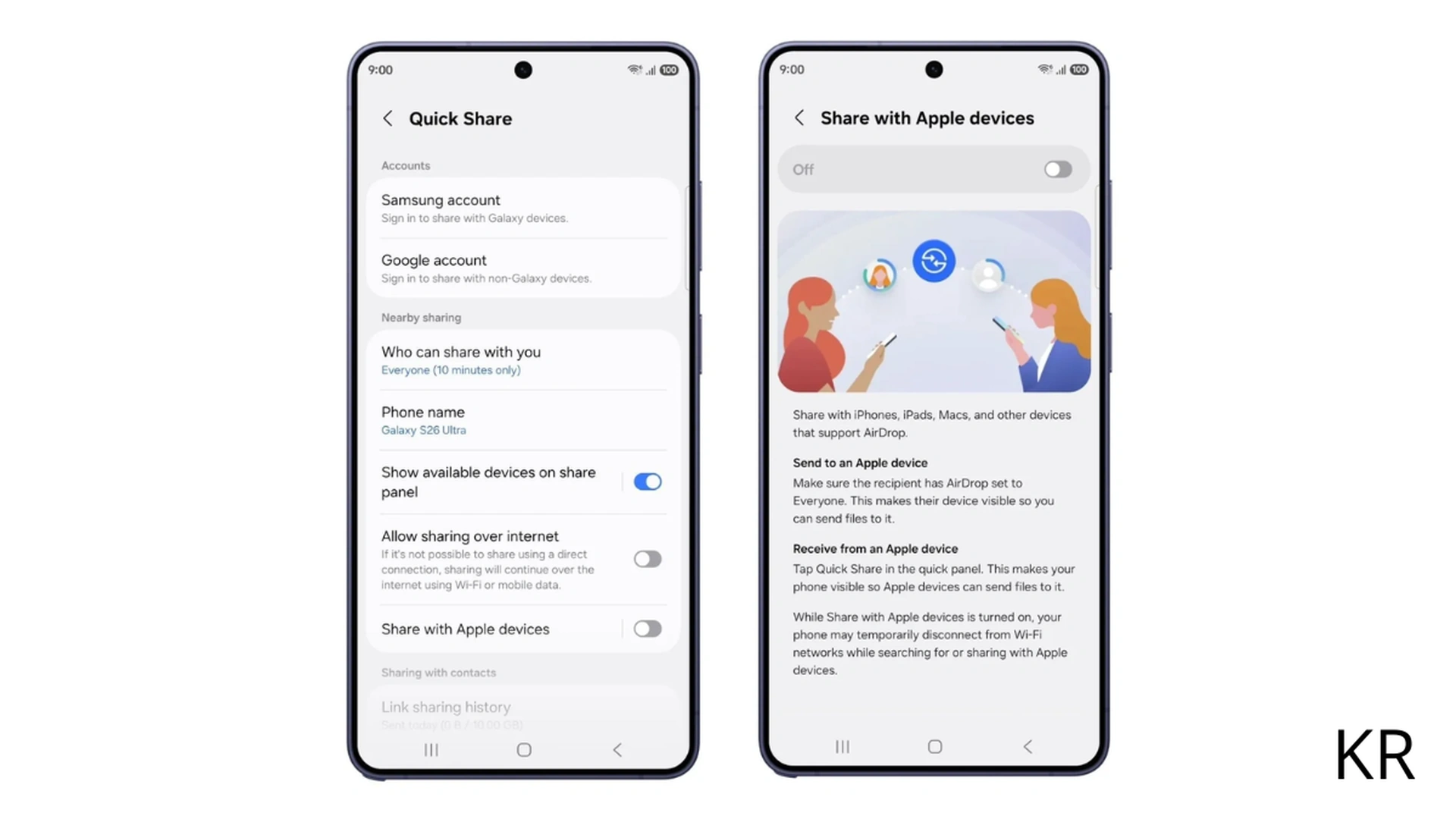
The update introduces a new option labeled for sharing with Apple devices. This marks a notable shift in Samsung’s approach, as the company has traditionally focused on strengthening its own ecosystem rather than integrating closely with competitors.
On the surface, this feature offers a convenient solution for users who frequently transfer files between Android and Apple devices. It aims to remove the need for third party apps or cloud based workarounds, providing a faster and more seamless experience similar to Apple’s AirDrop.
Early rollout shows inconsistent availability across devices
Despite the excitement surrounding this feature, its availability remains inconsistent. Some users report seeing the new sharing option within Quick Share, while others with the same devices and software versions do not have access to it.
Even among users who can access the feature, functionality appears limited. In many cases, nearby Apple devices fail to appear during the sharing process. Similarly, Galaxy devices do not consistently show up within Apple’s AirDrop interface. This creates a fragmented experience that undermines the purpose of seamless file sharing.
The inconsistency suggests that Samsung is rolling out the feature in phases rather than through a unified update. This kind of staggered deployment often involves server side activation, which can lead to variations in user experience depending on region, device configuration, and update status.
Multiple updates required before feature becomes visible
Another challenge for users is the requirement to update several system components before the feature becomes available. Reports indicate that updating device firmware alone may not be sufficient. Users may also need to install the latest versions of Google Play System updates and Google Play Services.
This multi layer update process adds complexity and reduces accessibility, particularly for users who expect such features to be enabled automatically through a single software update. It also highlights that the feature is still under refinement and not yet ready for a full scale release.
From a usability perspective, a feature designed to simplify file sharing should not require multiple manual steps before it can be used. Until this process becomes more streamlined, the benefit remains limited.
Samsung responds to growing demand for cross platform convenience
Samsung’s move comes in response to increasing demand for interoperability between different ecosystems. Modern users often own devices from multiple brands, and seamless connectivity has become a key expectation rather than a luxury.
Last year, Google introduced similar functionality with its Pixel devices, enabling improved compatibility with Apple’s file sharing system. Samsung’s latest update can be seen as a strategic response to that development, ensuring that Galaxy users are not left behind in terms of cross platform convenience.
This shift also reflects a broader industry trend where companies are gradually opening up their ecosystems to improve user experience. While Apple continues to maintain a tightly integrated environment, competitors are focusing on flexibility and compatibility as key differentiators.
Real world usefulness depends on reliability and performance
While the concept of cross platform file sharing is compelling, its real world value depends entirely on reliability. Users expect such features to work instantly and consistently, especially in situations where quick file transfers are essential.
At present, the feature does not meet those expectations. Reports of devices failing to detect each other and inconsistent functionality suggest that further optimization is needed. Without dependable performance, the feature risks becoming more of a novelty than a practical tool.
Samsung will need to address these issues before rolling out the feature widely. Ensuring stable connectivity, faster detection of nearby devices, and a simplified setup process will be critical to its success.
What Galaxy users should do now
For users who own supported Galaxy devices, it is advisable to install all available updates, including system firmware, Google Play System updates, and Google Play Services. After updating, users can check the Quick Share settings to see if the Apple sharing option is available.
However, those who rely heavily on cross platform file sharing for work or travel may want to wait until Samsung officially confirms that the feature is fully functional. Early adoption may lead to frustration due to inconsistent performance.
A promising feature that needs refinement before full release
Samsung’s effort to bring AirDrop style functionality to its devices represents an important step toward a more connected and flexible digital ecosystem. It demonstrates the company’s willingness to adapt to changing user needs and compete with both Google and Apple in meaningful ways.
However, the current rollout highlights the challenges of implementing such features at scale. Until the experience becomes stable and universally accessible, it remains a work in progress rather than a finished solution.
In the long run, if Samsung can refine and fully deliver this feature, it could significantly enhance the daily experience of Galaxy users, especially those who navigate between different platforms. For now, patience will be key as the company continues to fine tune its approach.