
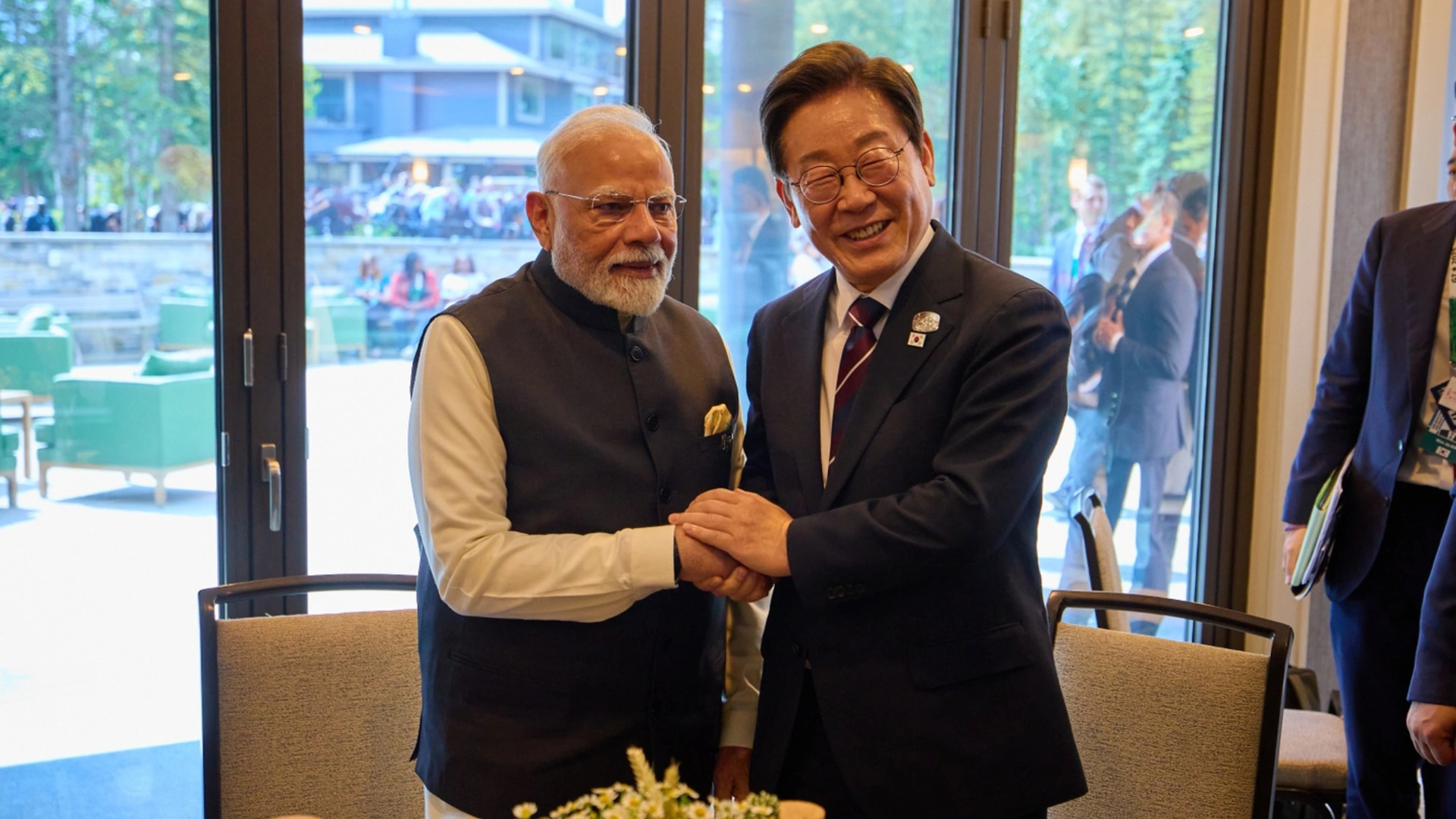
New Delhi: Prime Minister Narendra Modi on Monday held high level talks with South Korean President Lee Jae-myung during the visiting leader’s three day state trip to India, in a meeting expected to deepen economic cooperation, expand technology partnerships and strengthen the broader strategic relationship between the two Asian democracies.
President Lee’s visit, his first to India since assuming office, comes at a moment when governments across Asia are reassessing trade networks, supply chains and geopolitical alignments amid slowing global growth, energy risks and rising regional tensions. Officials from both countries described the trip as an important milestone in advancing the India South Korea Special Strategic Partnership.
Ceremonial welcome reflects growing importance of ties
President Lee was accorded a ceremonial reception in New Delhi, including official honours at Rashtrapati Bhavan. He was welcomed by President Droupadi Murmu and Prime Minister Modi in a display of diplomatic warmth that underscored the importance both capitals attach to the relationship.
Lee was accompanied by First Lady Kim Hea kyung during the visit. The presidential couple also paid tribute to Mahatma Gandhi at Rajghat, a symbolic gesture highlighting the cultural respect and historical goodwill that continue to shape bilateral ties.
Such ceremonial moments often carry strategic meaning, especially during state visits where symbolism and policy move together. In this case, the public messaging was clear: India and South Korea see each other as trusted long term partners in Asia.
Trade, investment and manufacturing expected to dominate agenda
Economic cooperation is expected to remain at the centre of the discussions. India and South Korea have steadily expanded commercial engagement over the past decade, with bilateral trade rising sharply and nearing USD 27 billion in the latest fiscal period.
Officials said both leaders were expected to discuss fresh investment flows, manufacturing partnerships and improvements to the existing economic partnership agreement signed in 2010. Businesses in both countries have long argued that upgrading trade frameworks could unlock stronger movement in goods, services and technology.
For India, South Korean investment can support domestic manufacturing ambitions in sectors such as electronics, automobiles, batteries, heavy engineering and infrastructure. For South Korea, India offers scale, a growing consumer market and an increasingly attractive destination for companies seeking to diversify production bases beyond traditional centres.
The meeting is also likely to encourage private sector confidence, particularly at a time when multinational firms are looking for stable long term markets with policy continuity.
AI, semiconductors and shipbuilding gain strategic urgency
A major focus of the summit is emerging technology. Both countries are expected to explore cooperation in artificial intelligence, semiconductor ecosystems and advanced industrial supply chains.
India has accelerated efforts to build domestic chip manufacturing capacity and digital innovation systems. South Korea, home to some of the world’s leading technology companies and advanced semiconductor expertise, is viewed as a valuable partner in that journey.
Closer semiconductor cooperation could involve research partnerships, talent development, equipment ecosystems and future manufacturing investments. In an era where chips power everything from smartphones to defence systems, such collaboration carries both economic and strategic value.
Shipbuilding is another area gaining importance. South Korea is a global leader in shipbuilding and maritime engineering, while India is expanding port capacity, naval capabilities and commercial maritime infrastructure. Deeper collaboration could create new opportunities in industrial production, logistics and coastal development.
Strategic partnership expands beyond economics
While trade and investment are central themes, the relationship now stretches far beyond commerce. India and South Korea increasingly share interests in maritime stability, open supply chains and a balanced Indo Pacific order.
Both nations are democratic economies with advanced technology ambitions and strong export interests. That creates natural overlap in policy thinking on resilience, connectivity and regional security.
Talks were also expected to touch on developments concerning the Korean Peninsula. India has traditionally supported peace, dialogue and denuclearisation efforts while maintaining constructive engagement with all sides where possible.
For Seoul, stronger ties with major regional players such as India can widen diplomatic options and economic partnerships. For New Delhi, closer relations with South Korea help strengthen engagement with East Asia and diversify strategic cooperation in a rapidly changing region.
Middle East tensions add urgency to energy discussions
The visit is taking place against a tense global backdrop, especially concerns surrounding the Strait of Hormuz, one of the world’s most critical energy shipping routes.
Any disruption in the region can affect oil prices, shipping insurance costs and supply certainty for major importing nations. South Korea, heavily dependent on imported fuel, remains particularly sensitive to such developments. India also closely monitors volatility in global energy markets due to its large import needs.
This broader context gives added urgency to discussions on resilient supply chains, maritime security and diversified economic partnerships. As geopolitical shocks become more frequent, countries are increasingly using bilateral relationships to reduce vulnerability.
Why this visit matters for India
For India, the significance of the summit lies in attracting high value investment, accessing advanced technology and reinforcing its position as a leading growth market. Stronger ties with South Korea can support job creation, manufacturing depth and export competitiveness.
The visit also signals confidence in India’s economic trajectory. When global leaders prioritise New Delhi for strategic outreach, it reflects India’s growing weight in international decision making.
Why this visit matters for South Korea
For South Korea, India represents opportunity at scale. A young population, expanding middle class, digital adoption and infrastructure growth make India an increasingly important long term market.
As global companies rethink concentration risks in supply chains, South Korean firms may see India as both a production hub and a demand centre. Closer political ties can help accelerate that shift.
Outlook after the summit
The true measure of the visit will depend on what follows the ceremonies and statements. If the two sides move quickly on investment approvals, technology roadmaps, trade facilitation and institutional cooperation, the summit could become a turning point in the relationship.
Even without dramatic announcements, the optics are powerful. At a time of economic uncertainty and geopolitical strain, India and South Korea are choosing deeper engagement over hesitation.
That message alone carries weight across Asia and beyond.