
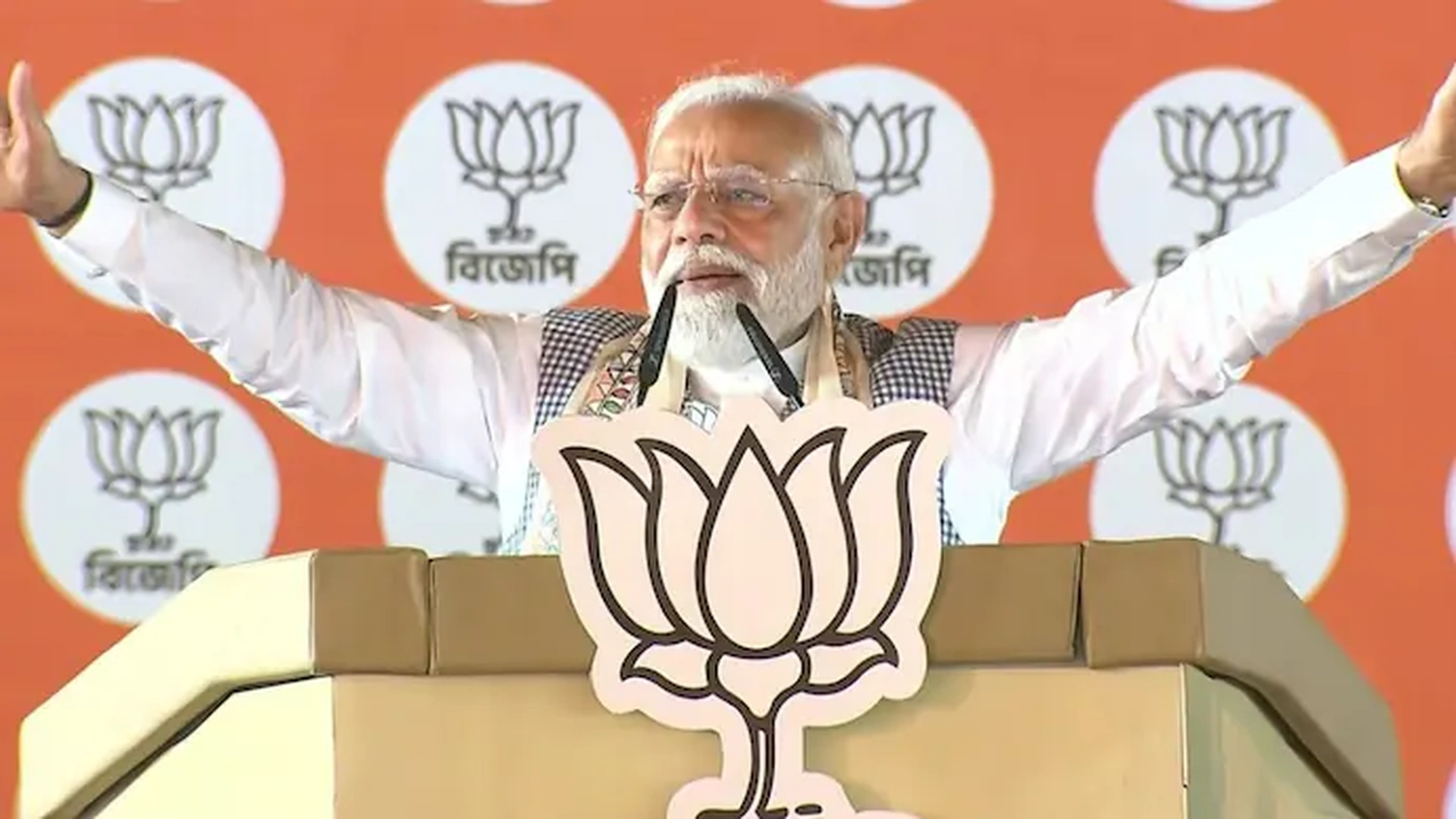
KOLKATA: Prime Minister Narendra Modi on Sunday placed women’s welfare at the centre of the Bharatiya Janata Party campaign in West Bengal, using a packed day of election rallies to promise financial support, healthcare benefits and political empowerment for women ahead of the first phase of the Assembly elections on April 23.
Addressing four rallies across Bankura, Purulia, Jhargram and Midnapore within six hours, the Prime Minister sharply attacked the ruling Trinamool Congress and the Congress party, accusing them of acting against women’s interests and obstructing legislative reforms meant to expand women’s representation in politics.
Modi said the coming election would mark a turning point for Bengal and asserted that the BJP was heading toward victory with a strong public mandate.
Women Focused Welfare Promises Dominate Campaign Message
At his first rally of the day in Barjora, Bankura district, Modi outlined a series of welfare promises aimed at women and families. He said pregnant women would receive Rs 21,000 in assistance, followed by another Rs 5,000 after childbirth.
He also announced free cervical cancer vaccination and said affordable medicines would be made available through Jan Aushadhi centres at discounts of up to 80 percent.
The Prime Minister said many women often avoid treatment because of medical costs and claimed the BJP’s welfare model was designed to remove those barriers.
“Women’s welfare is Modi’s guarantee,” he declared, making the slogan the central theme of the day’s campaign.
He further said women would receive annual support of Rs 36,000 under proposed schemes and would be entitled to free treatment worth up to Rs 5 lakh, along with free dialysis services at government hospitals.
Sharp Attack Over Women’s Reservation Law
Modi also used the rallies to attack Trinamool Congress over the issue of women’s political representation. Referring to the women’s reservation framework that seeks to reserve 33 percent seats in the Lok Sabha and state legislatures, he accused Trinamool of opposing amendments linked to the law.
He said women from villages and districts entering legislatures in larger numbers would demand accountability and challenge corruption.
According to Modi, the ruling party in Bengal fears women lawmakers who could question governance failures and misconduct. He further alleged that Trinamool and Congress worked together to block reforms.
Calling the party “anti woman” and “maa virodhi,” he said Bengal’s women voters would respond strongly at the ballot box.
Direct Outreach in Jhargram Draws Attention
During the intense campaign schedule, Modi made an unscheduled stop at a jhalmuri stall in Jhargram, interacting briefly at the local food shop. Videos of the moment quickly circulated online and drew widespread attention on social media.
The stopover added a personal outreach element to a campaign day otherwise dominated by political speeches and large public gatherings.
Reservation and Constitution Debate Intensifies
The Prime Minister also accused Trinamool Congress of attempting to introduce reservation based on religion through inclusion of Muslims in Other Backward Classes quotas.
He said such moves were against the spirit of the Constitution and sought to frame the issue as one of legal and social fairness.
Reservation policy has remained a politically sensitive issue in Bengal, where identity, community representation and welfare benefits continue to shape electoral narratives.
Infiltration and Identity Concerns Raised
Another major theme of Modi’s speeches was border security and alleged infiltration. He warned that Bengal risked losing its identity if illegal entry into the state continued unchecked.
He accused Trinamool Congress of protecting infiltrators for political purposes and said such a policy would damage the cultural and linguistic character of Bengal.
The BJP has repeatedly raised infiltration and border management as key election issues in the state, particularly in districts close to international borders.
Tribal Outreach and Political Symbolism
Modi also targeted Trinamool on tribal welfare, accusing the party of neglecting tribal districts and allowing illegal mining and unemployment to worsen in forest belt regions.
He cited the election of India’s first tribal woman President under BJP backed leadership as evidence of the party’s commitment to tribal representation.
The Prime Minister claimed Trinamool opposed that historic elevation and said BJP had also chosen tribal leaders as chief ministers in Assam, Odisha and Chhattisgarh.
He contrasted those appointments with what he described as underdevelopment in Bengal’s tribal regions, particularly in Jangalmahal.
Farmers and Cold Storage Politics
The Prime Minister turned to agricultural distress, especially concerns of potato and rice farmers. He alleged that syndicates linked to the ruling establishment controlled cold storages and exploited farmers through unfair systems.
Modi promised that a BJP government would dismantle such networks and restore fair access for growers.
He also pledged an annual grant of Rs 9,000 for each farmer and implementation of a crop insurance scheme in the state.
Agriculture remains a crucial electoral issue in Bengal, especially in rural belts where price fluctuations, storage costs and procurement concerns directly affect livelihoods.
Bengal Election Battle Enters Crucial Phase
Sunday’s rallies were among Modi’s final major campaign appearances before the first phase of voting begins on April 23. The high energy schedule reflected the importance BJP is placing on Bengal, one of the country’s most politically watched battlegrounds.
With women voters, farmers, tribal communities and youth all central to the campaign narrative, the Prime Minister’s speeches sought to widen BJP’s appeal beyond traditional support bases.
For Trinamool Congress, which has governed the state for years, the challenge remains defending its welfare record and regional identity politics against an aggressive national campaign.
High Stakes Contest Ahead
As Bengal moves closer to polling day, the contest has become a clash of competing models of governance. BJP is presenting promises of welfare expansion, law and order, and political change. Trinamool is expected to counter with its own record on social welfare, regional pride and grassroots delivery.
Modi’s message on Sunday was clear and repeated across districts: women’s welfare, governance accountability and economic support would be the BJP’s core pitch to Bengal voters.
Whether that message converts into votes will be known once the first phase of polling begins later this week.