
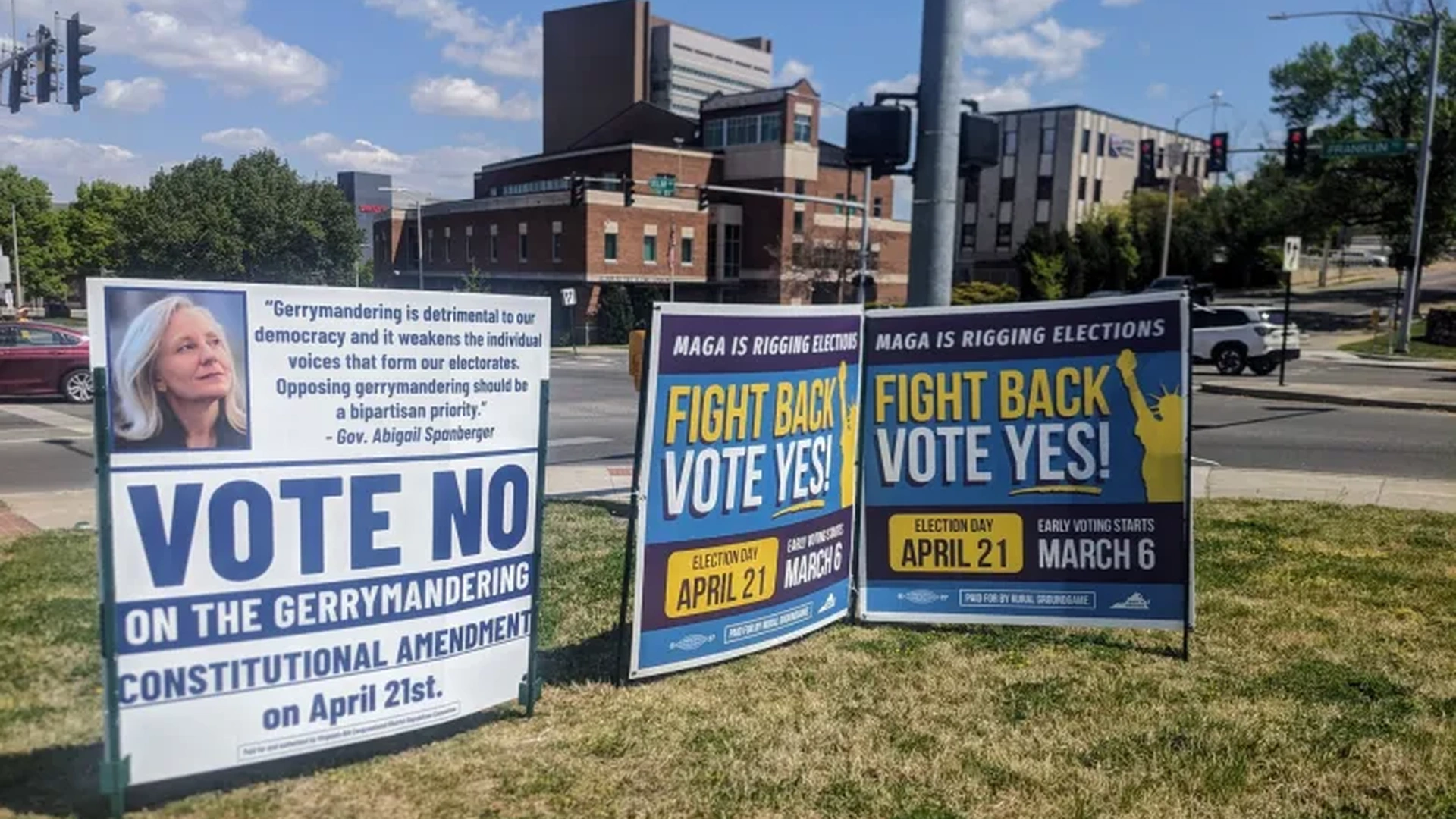
Virginia voters have narrowly approved a high stakes congressional redistricting referendum, delivering a potentially significant advantage to Democrats ahead of the 2026 United States midterm elections. The closely watched ballot measure passed Tuesday with 50.3 percent support and 49.7 percent opposition, according to results called by the Associated Press.
The outcome could reshape Virginia’s political map and strengthen Democratic hopes of regaining control of the U.S. House of Representatives. Under the newly approved boundaries, analysts project that 10 of Virginia’s 11 congressional districts would favor Democrats, while one district would favor Republicans.
The referendum became one of the most intensely contested political fights in the state this year, drawing national attention, heavy spending, and a wave of campaign advertisements from both parties.
Why the Virginia vote matters nationally
Virginia currently sends 11 members to the House, with Democrats holding six seats and Republicans holding five. The new map approved by voters is expected to dramatically alter that balance.
If the projected partisan lean of the districts holds, Democrats could gain a clearer path to adding several seats from Virginia alone. In a closely divided House, even a handful of changes can influence which party controls Congress after the midterms.
National Democratic groups framed the referendum as a push for fairer representation and a response to recent Republican favorable redistricting efforts in other states. Party strategists argued the new boundaries would help level the playing field in a year expected to feature fierce national competition.
Republicans, however, described the measure as an attempt by state politicians to engineer favorable districts for Democrats.
Temporary map to be used before next census cycle
The newly approved congressional boundaries are expected to be used for the 2026 midterm elections. Virginia is then scheduled to return to its regular redistricting framework after the 2030 census, a process led by an independent commission.
That temporary nature did little to reduce the political stakes. With control of the House likely to be decided by a narrow margin, both parties treated the referendum as one of the most consequential state level contests of the year.
Millions of dollars were spent by advocacy groups, party organizations, and outside political committees seeking to influence voters.
Republicans challenge measure in court
Even with the referendum approved, legal uncertainty remains.
Republican aligned groups have filed multiple lawsuits seeking to block implementation of the maps. They argue the process used by Virginia lawmakers to place the measure on the ballot did not follow constitutional and procedural requirements.
They have also claimed the redrawn districts weaken the influence of minority communities and rural voters.
As of now, those cases remain active in Virginia courts. Unless judges intervene, the maps already adopted by lawmakers are expected to guide the next congressional elections.
Major changes expected across Hampton Roads
One of the biggest political impacts is expected in the Hampton Roads region, where several districts would be significantly reshaped.
The changes could force current officeholders and future candidates to reconsider where they run, while also placing many voters into districts represented by new members of Congress.
Political observers say Hampton Roads may become one of the most closely watched battleground regions in the country once campaigning begins.
First District faces dramatic transformation
Virginia’s current First Congressional District has long leaned Republican and is represented by Rob Wittman, who has held the seat since 2007.
Under the new boundaries, the district would be transformed so extensively that it would bear little resemblance to its current map.
Communities including James City County, York County, and Williamsburg would move into a newly configured Eighth District. That district would stretch from York County through Spotsylvania County and include a narrow corridor reaching parts of Northern Virginia, including Alexandria.
Based on recent voting patterns cited by the Virginia Public Access Project, the redesigned Eighth District would favor Democrats by a 63.1 percent to 36.9 percent margin.
That shift would make it one of the clearest Democratic leaning districts in the state.
Second District turns into a prime battleground
Another key area is the Second Congressional District, represented by Jen Kiggans.
The district currently leans Republican, but under the new map it would tilt toward Democrats. Estimates suggest a partisan balance of 54.5 percent Democratic to 45.5 percent Republican.
That change could make the seat one of the most competitive races in the country and a major target for Democratic campaign spending.
Third District remains safely Democratic
Virginia’s Third Congressional District, represented by Bobby Scott, would remain a strong Democratic seat under the new boundaries.
The district is also expected to gain Poquoson as part of the reshuffle.
While less competitive than neighboring districts, the Third District’s stability could help Democrats consolidate support in the broader region.
Chesapeake voters to see boundary changes
The city of Chesapeake would experience notable voter redistribution between the Second and Third districts.
Residents there may find themselves voting in new districts and represented by different members of Congress depending on their location within the city.
Such changes often reshape campaign strategies, fundraising priorities, and local policy debates.
What comes next for Virginia politics
The referendum result marks a turning point in Virginia politics and sets the stage for an intense election cycle.
Candidates from both parties are now expected to evaluate whether to stay in their current districts, challenge incumbents elsewhere, or seek open seats created by the new lines.
For Democrats, the vote represents a rare structural opportunity in a state already trending competitive at the federal level.
For Republicans, it creates an urgent need to defend vulnerable districts while continuing court challenges.
With the House majority potentially hanging in the balance, Virginia has moved from a routine state contest to a central battlefield in America’s 2026 midterm fight.