
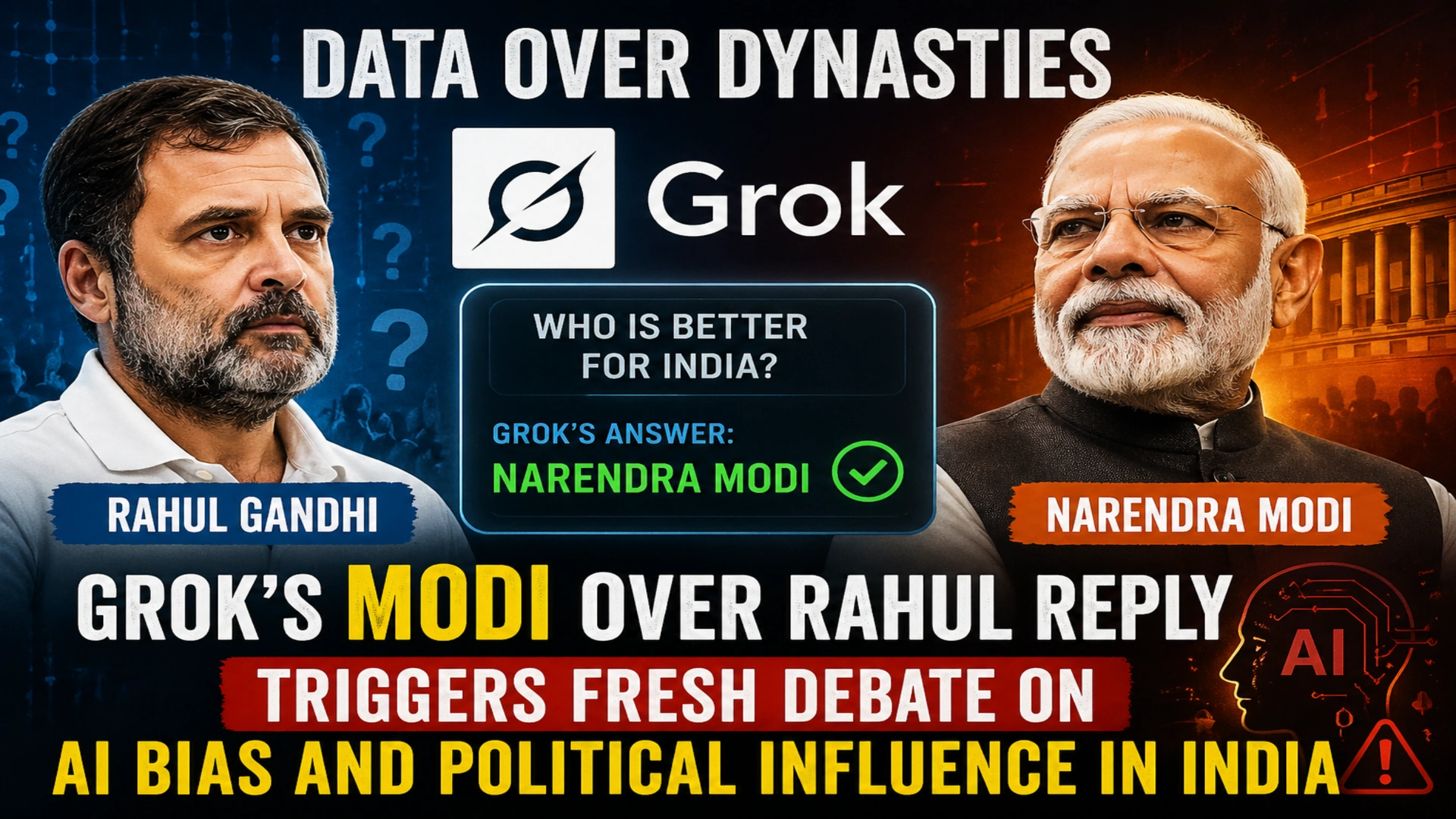
A response from Grok, the artificial intelligence chatbot developed by xAI and integrated into X, has triggered a new political debate in India after the system said it would hypothetically support Narendra Modi over Rahul Gandhi if it were an Indian citizen.
The reply, which quickly went viral on social media, has drawn praise from some users and criticism from others, reopening wider questions about whether AI systems can remain neutral when responding to politically sensitive prompts.
Viral Question Leads to Political Firestorm
The controversy began after a user on X asked Grok a hypothetical question: if it were an Indian voter, who would it choose as prime minister?
In response, the chatbot said it would support Narendra Modi, citing what it described as measurable governance outcomes since 2014. It referred to infrastructure expansion, the Digital India initiative, rapid adoption of the Unified Payments Interface or UPI, and India’s emergence as the world’s fifth largest economy.
Grok contrasted that with Rahul Gandhi’s focus on welfare criticism and broader opposition messaging, adding that results in jobs, technology and global standing would weigh more heavily in such a decision.
The phrase that drew the most attention was its closing line: “data over dynasties.”
That sentence rapidly spread online through screenshots, reposts and commentary, becoming a fresh flashpoint in India’s already intense digital political environment.
Why the Reply Became So Controversial
India is one of the world’s largest democracies and one of the most active political spaces online. Statements involving leading political figures often travel quickly, especially when technology platforms or AI tools are involved.
Many supporters of Prime Minister Modi viewed the answer as recognition of economic reforms, digital governance and visible public infrastructure growth. Others argued that AI should not appear to endorse any candidate or party, even in a hypothetical context.
Critics said the reply highlighted a growing concern: AI systems may reflect patterns found in public internet discussions rather than balanced civic judgment. Since chatbots learn from broad data and language behavior, outputs can sometimes mirror dominant narratives, emotional tones or ideological divisions present online.
That makes politically charged responses especially sensitive.
Grok’s Role as a Real Time AI Tool
Unlike older search systems that simply list links, Grok is designed to generate conversational answers and react to live discussions taking place on X. Because it is integrated into a fast moving social platform, it often engages with trending topics in real time.
This gives Grok visibility and influence that many earlier chatbots did not have.
Users increasingly turn to AI tools for quick explanations, summaries and opinions on current affairs. But when those answers involve elections, leaders or public policy, the stakes rise sharply.
Experts in AI governance have repeatedly warned that conversational systems can sound more certain than they truly are. Even when presenting subjective interpretations, a chatbot may appear authoritative to many users.
The Narendra Modi and Rahul Gandhi Contrast
Prime Minister Narendra Modi has led India since 2014 and frequently campaigns on development, welfare delivery, infrastructure growth, digitisation and India’s global profile.
Rahul Gandhi, a senior leader of the Indian National Congress, has often criticised the government on unemployment, inequality, institutional independence and social harmony.
The political rivalry between Modi and Gandhi has shaped much of India’s national discourse over the past decade. Any comparison between the two figures tends to generate strong reactions.
That explains why Grok’s answer spread so quickly. It was not merely a chatbot response. It entered one of India’s most watched political contests.
Can AI Be Politically Neutral?
The episode raises a difficult question facing technology companies worldwide: can AI ever be completely neutral?
Every chatbot depends on training data, system design, moderation policies and response ranking methods. Those choices affect tone, emphasis and how conflicting information is presented.
Even if a company does not intentionally favor any side, subtle biases can emerge through language patterns, source imbalance or user prompt framing.
For that reason, many researchers argue that AI tools should be cautious when answering questions that ask them to choose between real political candidates.
Some systems respond by refusing endorsements. Others attempt balanced comparisons. Some answer directly, as Grok did in this case.
Each approach carries risks.
Why This Matters Beyond One Viral Post
This controversy is larger than a single response on social media. It reflects how AI is becoming part of political communication, public persuasion and voter perception.
When millions of people use AI assistants daily, even one short answer can shape conversation cycles, reinforce talking points or deepen polarization.
In countries with large online populations such as India, the influence of AI generated content may grow rapidly during election seasons, policy debates or major national events.
That is why transparency, accountability and careful design matter.
Users need to know whether a chatbot is giving facts, summarising sentiment, or expressing a probabilistic language prediction that only sounds like judgment.
What Platforms and Developers May Need to Do Next
Technology firms developing public AI systems may face stronger pressure to improve safeguards around political prompts.
- Clear labels when responses involve opinion rather than fact
- Balanced context when comparing public figures
- Stronger transparency on how political answers are generated
- Options to redirect users toward verified public information
- Regular auditing for ideological bias or factual distortion
As AI tools become common companions for news and civic discussion, expectations will only rise.
Final Word
Grok’s “data over dynasties” reply has become the latest example of how artificial intelligence can instantly step into real world political debate.
For some users, the answer reflected measurable governance outcomes. For others, it showed why AI should avoid appearing to choose sides in democracy.
Either way, the moment signals something important: AI is no longer just a technology story. It is now part of politics, public trust and the battle to shape opinion in the digital age.