
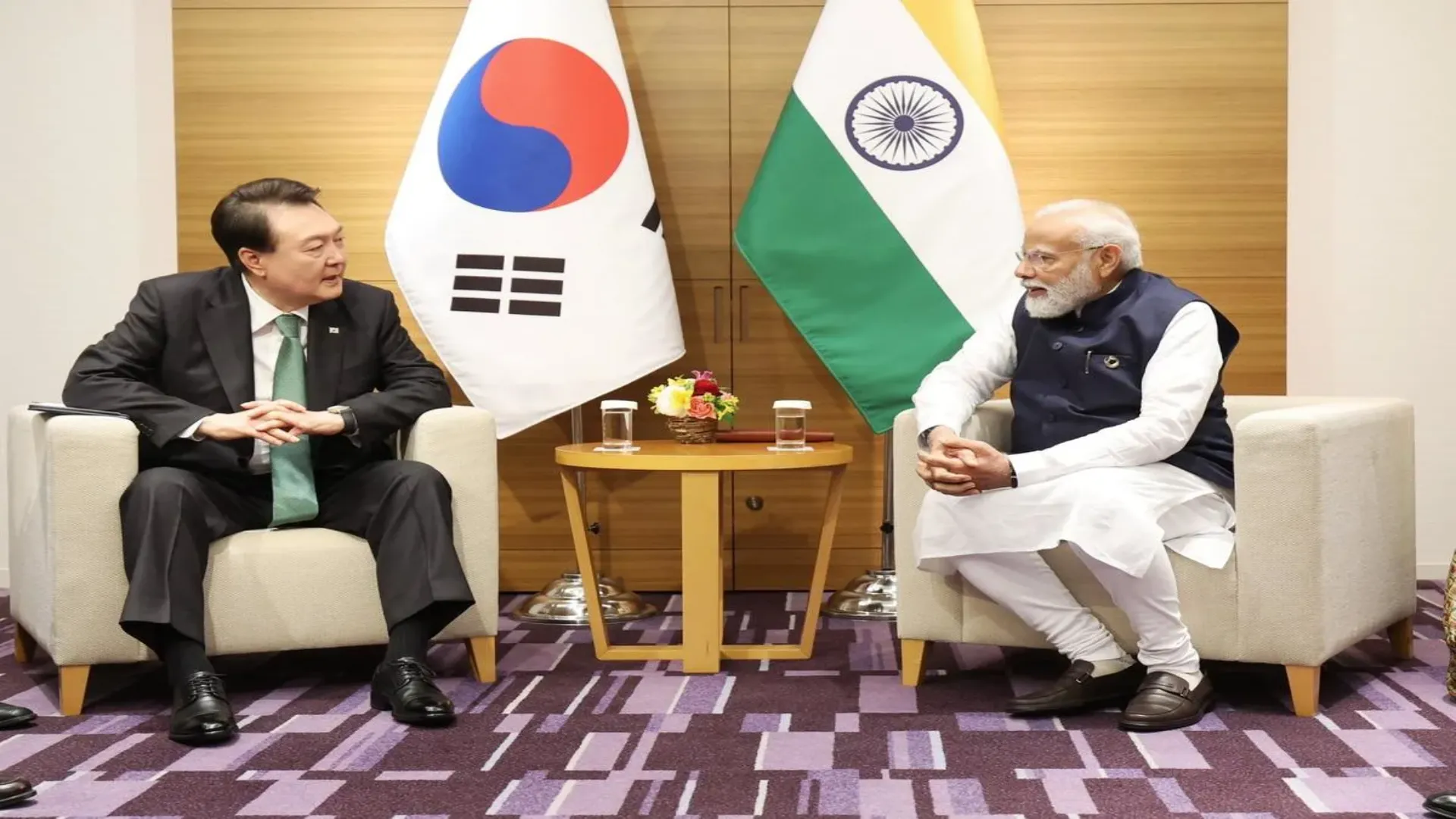
Prime Minister and South Korean President on Monday held wide ranging talks in New Delhi, unveiling an ambitious roadmap to deepen ties in technology, trade, clean energy and strategic cooperation across the Indo Pacific.
The high profile visit marked a fresh phase in relations between two of Asia’s major democracies, with both leaders presenting their partnership as a force for growth, stability and innovation.
President Lee’s three day State visit from April 19 to 21 is his first trip to India since taking office. It also comes after an eight year gap in a South Korean presidential visit to India, giving added diplomatic weight to the meeting.
Speaking after bilateral talks, Modi described the visit as highly significant and said India and South Korea are ready to shape the next decade of cooperation.
He underlined that both nations are bound by democratic values, support for a market economy and respect for the rule of law.
New momentum for a strategic partnership
India and South Korea have steadily expanded their relationship over the past two decades, but Monday’s talks signalled a sharper focus on future industries and geopolitical coordination.
The two sides reaffirmed their commitment to the Special Strategic Partnership, a framework that guides cooperation in economics, security, technology and people to people exchanges.
Officials said the leaders reviewed progress across sectors and agreed to accelerate high value collaborations.
Modi said the relationship now carries importance beyond bilateral interests, especially at a time of global uncertainty and shifting economic supply chains.
He added that both countries can contribute jointly to peace, resilience and prosperity in the wider region.
India Korea Digital Bridge launched
One of the biggest announcements from the summit was the launch of the India Korea Digital Bridge, an initiative designed to connect the innovation ecosystems of both countries.
The platform is expected to expand collaboration in artificial intelligence, semiconductors, information technology and advanced digital infrastructure.
It is also aimed at encouraging research partnerships, startup engagement and greater private sector participation.
For India, the initiative fits into a larger push to become a global manufacturing and technology hub.
For South Korea, it offers deeper access to one of the world’s fastest growing digital markets.
The semiconductor sector is likely to receive particular attention, as many countries seek trusted partners and diversified supply chains in the face of global disruptions.
Trade target raised to 50 billion dollars by 2030
Economic ties were another major pillar of the talks.
India and South Korea expressed confidence that bilateral trade can nearly double to 50 billion dollars by 2030, up from the current level of 25.7 billion dollars.
To support that goal, both sides are working to upgrade the Comprehensive Economic Partnership Agreement, which has governed trade relations for years.
A revised agreement could ease market access, remove barriers and create fresh opportunities for exporters and investors.
South Korean companies already have a visible presence in India in sectors such as electronics, automobiles, shipbuilding and heavy industry.
Indian firms are also expanding in pharmaceuticals, software services and engineering.
Analysts say a stronger trade framework could help both countries reduce overdependence on single markets while creating jobs and industrial growth.
From chips to ships broad cooperation agenda
Modi used a memorable phrase to describe the breadth of the partnership, saying cooperation would grow “from chips to ships, from talent to technology, and from entertainment to energy.”
That vision reflects the wide range of sectors discussed during the visit.
Several memoranda of understanding were signed covering shipbuilding, emerging technologies and cultural exchanges.
Shipbuilding is a particularly relevant area as South Korea is one of the world’s leading maritime manufacturing powers, while India is expanding port infrastructure and naval capabilities.
Energy cooperation is also gaining ground, especially in renewables and future fuels.
South Korea’s participation in initiatives such as the was welcomed by India.
Shared Indo Pacific outlook
Regional security and strategic alignment formed an important part of the dialogue.
Modi said India and South Korea share a common outlook on the Indo Pacific, a region that has become central to global trade, maritime security and strategic competition.
The two leaders also discussed cooperation linked to the Indo Pacific Oceans Initiative, which promotes sustainable and rules based maritime governance.
India views South Korea as a valuable East Asian partner with advanced technological capabilities and growing regional influence.
South Korea, meanwhile, sees India as a rising power, major market and important balancing force in Asia.
Their closer coordination may also strengthen supply chain resilience and maritime connectivity in a period of global strategic tension.
Cultural ties remain a powerful bridge
Alongside business and strategy, both leaders highlighted the deep civilisational links between their peoples.
Modi referred to the story of Princess Suriratna of Ayodhya and King Kim Suro, a historical tradition cherished in Korea that symbolises ancient cultural bonds between the two countries.
He also noted the popularity of Korean culture in India, including music, cinema and television, while Indian traditions, yoga and cuisine continue to gain recognition in South Korea.
This soft power connection has helped create a warm public image of the relationship, particularly among younger generations.
Ceremonial welcome in New Delhi
President Lee was accorded a ceremonial reception at , where he was welcomed by President and Prime Minister Modi.
He later paid tribute to at , accompanied by First Lady Kim Hea Kyung.
During the visit, Lee also held discussions with External Affairs Minister and met a delegation of ministers, senior officials and business leaders.
In a symbolic gesture of long term friendship, Modi and Lee planted a tree together.
Why the visit matters now
The summit comes at a time when countries across Asia are reassessing trade routes, technology dependencies and strategic partnerships.
India and South Korea both want stronger manufacturing ecosystems, secure digital supply chains and diversified economic engagement.
For India, closer ties with Seoul can accelerate industrial modernisation and technology transfer.
For South Korea, deeper engagement with India offers growth potential in a vast consumer market and a trusted democratic partner.
The visit also sends a broader message that middle powers in Asia are prepared to work together on economic resilience and regional stability.
Outlook for the next decade
Monday’s talks in New Delhi appear to have given new energy to a relationship that has often held more promise than publicity.
With concrete targets on trade, digital innovation and strategic coordination, India and South Korea now seem determined to convert goodwill into measurable outcomes.
If the agreements announced during this visit are implemented effectively, the partnership could emerge as one of Asia’s most significant growth alliances in the coming decade.