
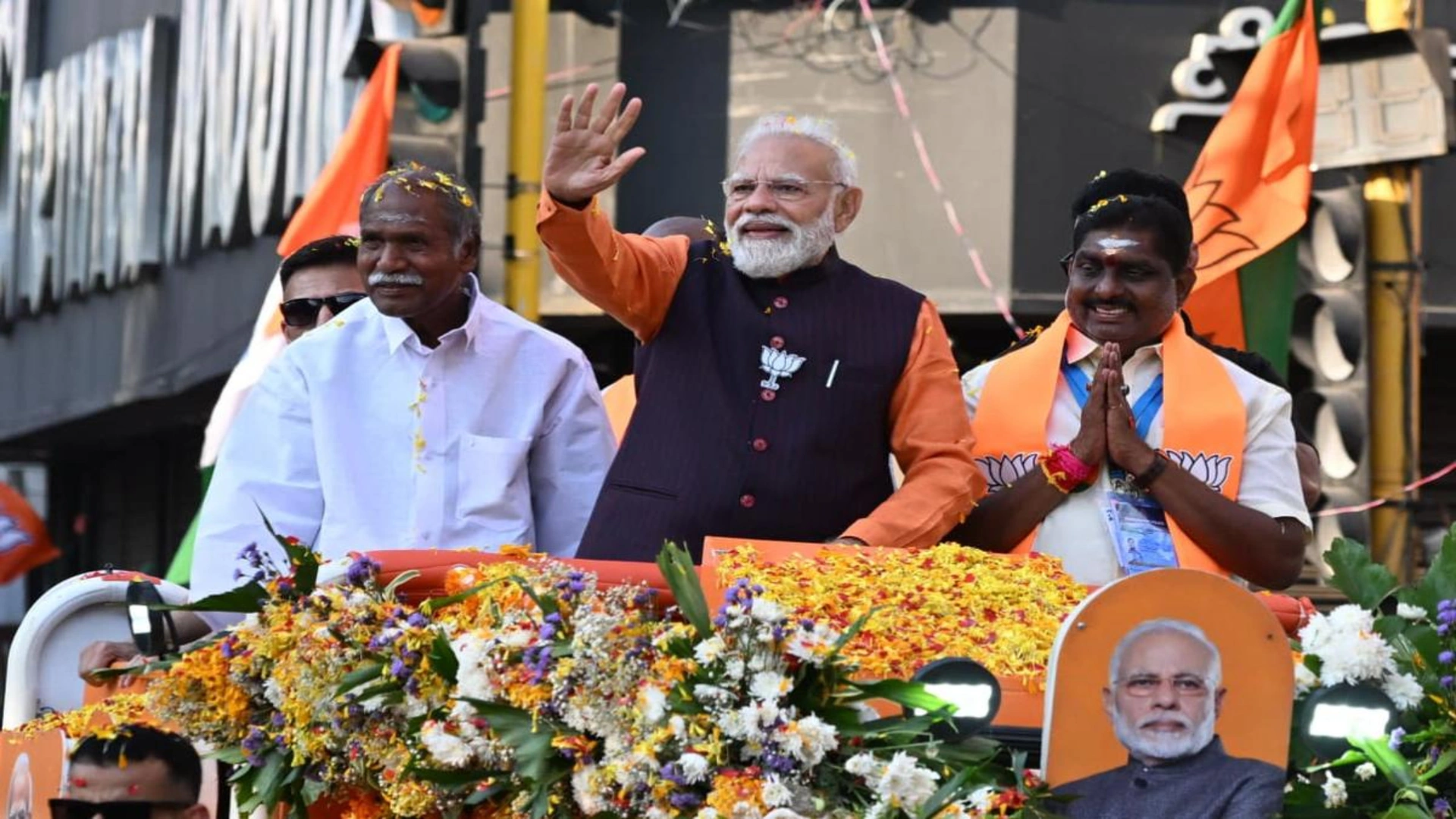
India’s 2026 Assembly election campaign intensified on Sunday with fresh political controversy surrounding Prime Minister Narendra Modi, while high voltage rallies unfolded across West Bengal and Tamil Nadu. Opposition parties accused the Prime Minister of violating the Model Code of Conduct, even as major regional leaders sharpened attacks ahead of polling day.
With voting dates drawing near, the political atmosphere in key States has turned increasingly combative, with governance, women’s reservation, corruption allegations, federal rights, and regional identity emerging as major election themes.
Complaints Filed Against PM Modi Over National Address
The latest controversy began after a recent national address by Prime Minister Modi, delivered while the Model Code of Conduct remains in force in five poll bound States.
Communist Party of India MP P. Sandosh Kumar wrote to Chief Election Commissioner Gyanesh Kumar alleging that the Prime Minister’s speech was political in nature and attempted to influence public opinion during an active election period.
According to the complaint, the address contained partisan claims and selective narratives linked to issues already under political debate. The letter also objected to the broadcast being carried on public platforms such as Doordarshan and Sansad TV, claiming misuse of State resources.
Separately, Communist Party of India (Marxist) and Congress leaders also raised similar objections before the Election Commission of India.
Mamata Banerjee Hits Back in Bengal
Mamata Banerjee strongly criticised the Prime Minister, accusing him of using government machinery for campaign purposes. She said the national address amounted to an illegal political campaign during the enforcement of election rules.
The West Bengal Chief Minister also said it was unfortunate that the Prime Minister chose to mislead the country over the women’s reservation issue rather than present facts honestly.
Banerjee led a roadshow in Bardhaman on Sunday, walking nearly two kilometres with party workers and supporters as the ruling All India Trinamool Congress intensified last minute mobilisation before voting.
She also accused opponents of trying to delete voter names and warned against attempts to impose citizenship linked policies in the State.
Modi Launches Sharp Attack on TMC
Campaigning across multiple districts in Bengal, Prime Minister Modi launched a strong attack on the Trinamool Congress government.
At rallies in Bishnupur, Bankura and Jhargram, he alleged that the ruling party had presided over corruption in teacher recruitment, public jobs, welfare schemes, MGNREGA works, and cyclone relief funds.
He said the Trinamool Congress had “betrayed women” by opposing the proposed constitutional amendment bill seeking 33 percent reservation for women in Parliament and State Assemblies before 2029.
The Prime Minister claimed women voters in Bengal would respond strongly in the upcoming election. He also framed the contest as a battle to protect Bengal’s identity, accusing the State government of favouring infiltrators over local citizens.
The BJP has made border security, corruption, welfare delivery, and women’s political participation central themes in its Bengal campaign.
Tamil Nadu Sees Fierce DMK vs NDA Battle
In Tamil Nadu, Chief Minister M. K. Stalin intensified attacks on the BJP led National Democratic Alliance.
Addressing a rally in Tiruppur, Stalin said Tamil Nadu’s progress would be affected if voters supported the NDA in the coming election. He argued that every major welfare initiative introduced by the Dravida Munnetra Kazhagam had become a landmark achievement.
He accused the All India Anna Dravida Munnetra Kazhagam and BJP of weakening industrial growth in parts of the State and said votes for the alliance would become obstacles to future development.
Stalin also unveiled the DMK’s Chennai focused “Super 6” manifesto, promising upgraded civic amenities, 1,000 new mini buses, AI based traffic systems, improved roads, stormwater infrastructure, and stronger action on stray animal management.
The manifesto additionally proposed a special centre for artificial intelligence, animation, gaming, visual effects, and immersive technology to position Chennai as a future ready economic hub.
Rahul Gandhi Targets AIADMK
Rahul Gandhi entered the Tamil Nadu campaign with a direct attack on AIADMK, calling it a mask for the BJP.
Speaking in Ponneri, Gandhi said the BJP was searching for a regional partner that would allow control of Tamil Nadu from Delhi. His remarks were aimed at strengthening opposition unity while portraying the election as a contest over State autonomy.
Tamil Nadu politics has often revolved around federal rights, language identity, and resistance to central domination, making the issue politically significant.
Election Commission Orders Key Police Transfer
In a significant administrative development, the Election Commission directed the Tamil Nadu government to appoint IPS officer Avinash Kumar as Inspector General of Police, Intelligence.
The transfer came just days before polling. The officer replaced was instructed not to be given any election related responsibilities until the completion of voting.
Such late stage administrative changes often signal the Commission’s effort to maintain neutrality and public confidence during closely watched contests.
Vijay Backs Independent Candidate
Actor turned politician Vijay announced support for independent candidate K. Premkumar in the Edappadi constituency after the nomination of his party candidate was rejected.
The move indicates that smaller and emerging political forces may still influence vote shares in tightly contested seats.
What Is at Stake
The Assembly elections in West Bengal and Tamil Nadu are being viewed as politically crucial for both national and regional parties.
For the BJP, gains in Bengal would strengthen its eastern expansion strategy, while progress in Tamil Nadu would mark a breakthrough in a State long dominated by Dravidian parties.
For Trinamool Congress and DMK, retaining power would reinforce regional leadership models and resistance to national party expansion.
With polling close and rhetoric rising, the final phase of campaigning is expected to remain intense, emotional, and sharply polarised. Voters now hold the decisive verdict on whether continuity, change, or coalition shifts will define the next chapter in these politically important States.