
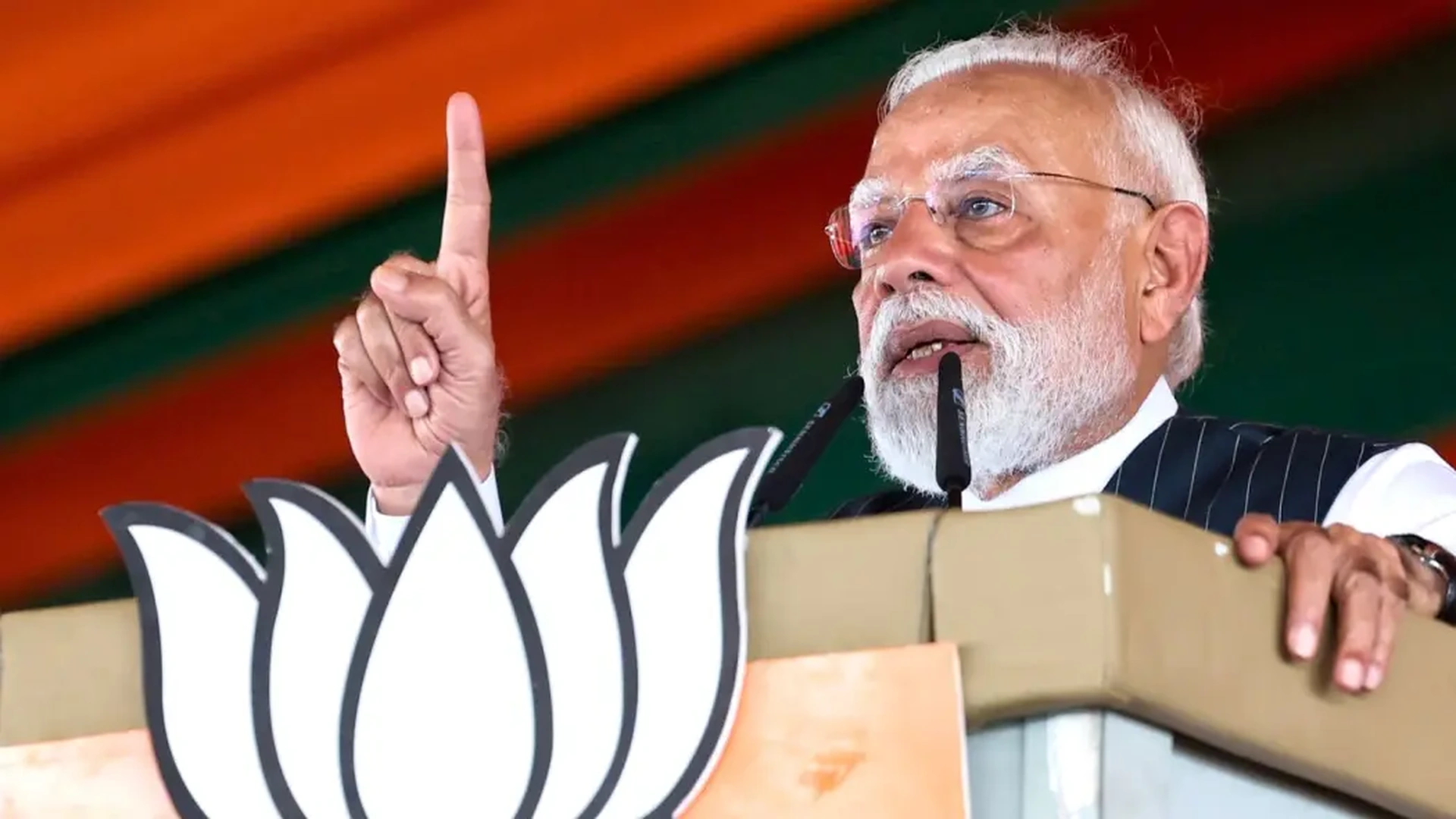
Prime Minister Narendra Modi on Sunday intensified the Bharatiya Janata Party’s campaign for the 2026 West Bengal Assembly elections, launching a sharp attack on the ruling Trinamool Congress government during a public rally in Purulia. Addressing a large gathering in the tribal belt of western Bengal, he accused the state administration of corruption, appeasement politics, administrative failure and neglect of tribal communities.
The Prime Minister framed the coming election as a choice between development and political favoritism, while urging voters to support a BJP government in the state alongside the party’s government at the Centre.
Modi Raises Language and Cultural Identity Issue
In one of the key themes of his speech, Modi alleged that West Bengal’s traditional language and cultural identity were being weakened due to infiltration and vote bank politics. He said the social character of the state was changing and accused the ruling party of prioritising political gains over preserving Bengal’s heritage.
He also claimed that indigenous and regional languages had not received the respect they deserved under the present administration. Referring specifically to Santali, he said tribal languages were being sidelined instead of promoted through policy and education.
The BJP has increasingly focused on identity politics in Bengal, especially in districts where tribal and regional linguistic communities hold significant electoral influence.
Focus on Tribal Belt and Junglemahal Politics
Purulia is part of the larger Junglemahal region, which includes districts such as Bankura and Jhargram. These areas have long been politically significant because of their tribal population and history of economic underdevelopment.
Modi repeatedly described the TMC government as presiding over what he called “Maha jungleraj,” accusing it of failing to provide roads, clean drinking water, jobs and essential public services in these districts.
He alleged that despite years in power, the state government had not delivered meaningful progress to communities in western Bengal. According to Modi, people in these districts were now looking for political change after years of disappointment.
The BJP has made sustained efforts in recent years to expand its support base in Junglemahal, where tribal voters can play a decisive role in close electoral contests.
Land Grab and Cut Money Charges Against TMC
The Prime Minister also accused local ruling party networks of illegally occupying tribal land and controlling access to government work through corruption.
He alleged that nothing moved without “cut money,” a phrase often used in Bengal politics to describe illegal commissions or bribes. According to him, this system had harmed poor families, discouraged honest governance and created fear among ordinary citizens.
Modi said when bribery becomes part of daily administration, industries lose confidence and investors stay away. He argued that corruption had damaged both governance and economic growth in the state.
The Trinamool Congress has repeatedly denied such allegations in the past and has often accused the BJP of making politically motivated claims during election campaigns.
Attack on Women Reservation Opposition Claim
Another major part of the speech focused on women’s political representation. Modi alleged that the TMC opposed the proposed 33 percent reservation for women in Parliament and state assemblies because it feared stronger female voices in politics.
He said more women legislators would raise issues of safety, opportunity and rights more forcefully, and accused the opposition of resisting such empowerment.
Women voters have become a crucial electoral bloc in West Bengal, where welfare schemes and household support programs often shape political preferences. Both the BJP and TMC are expected to make women centric promises a major part of their 2026 campaign strategy.
Unemployment and School Recruitment Scam Mentioned
The Prime Minister linked corruption with rising unemployment and said Bengal had faced serious joblessness during the TMC’s long tenure in office.
He referred to the school recruitment scam, one of the most controversial issues in recent state politics, and alleged that deserving youth were denied fair opportunities because appointments were manipulated.
Modi claimed thousands of young people suffered due to irregularities in teacher recruitment and said many schools were now functioning without adequate staff.
The recruitment controversy has remained a sensitive issue in Bengal politics, with opposition parties repeatedly targeting the ruling establishment over the matter.
Direct Appeal for Change in Bengal
Making a direct pitch to voters, Modi said the people of Purulia and surrounding regions were demanding change. Using the slogan “Paltano Darkar,” meaning change is needed, he suggested anti incumbency sentiment was visible across western Bengal.
He argued that whenever corruption and political excesses reach their peak, voters eventually choose an alternative. According to him, people now see the BJP as the only credible option capable of replacing the current government.
The Prime Minister then appealed for a BJP chief minister in West Bengal, saying the state needed alignment with the Centre for faster growth and stronger governance.
BJP Pushes Double Engine Narrative
Reinforcing the party’s familiar “double engine” campaign message, Modi said development moves faster when the same party governs both the state and the Centre.
He claimed that if Bengal elects a BJP government, Purulia and other backward districts would witness accelerated infrastructure growth, better welfare delivery and stronger economic opportunities.
The BJP has used this argument in several state elections, presenting coordination between New Delhi and state capitals as a path to quicker implementation of projects.
Comparison With BJP Ruled States
Modi also highlighted neighbouring BJP ruled states such as Odisha and Chhattisgarh, saying tribal communities had received higher political representation there.
He noted that tribal leaders had become chief ministers in those states and said this reflected the BJP’s commitment to inclusive leadership.
The Prime Minister further said the Union government had created a separate ministry for tribal affairs and increased dedicated funding for welfare programs aimed at indigenous communities.
Language Promise and Education Policy Pitch
Seeking to strengthen the BJP’s outreach on identity issues, Modi said his party respects all Indian languages and dialects. He cited the National Education Policy as a framework that supports learning in the mother tongue, especially for poor, rural and tribal children.
He promised that a BJP government in Bengal would strengthen Bengali, Santali, Kurmali and Rajbanshi languages. He also said it was under the BJP led Centre that Bengali received classical language status.
Language remains an emotionally significant issue in Bengal politics, and all major parties are expected to continue focusing on cultural identity during the election season.
High Stakes Contest Ahead
With the 2026 Assembly elections approaching, West Bengal is set for another high intensity political battle between the BJP and All India Trinamool Congress led by Chief Minister Mamata Banerjee.
Modi’s Purulia speech signals the BJP’s strategy of combining anti corruption messaging, tribal outreach, identity politics and development promises to challenge the ruling party in one of India’s most politically watched states.
As campaign momentum builds, Junglemahal and other swing regions may once again become decisive in shaping Bengal’s next government.