
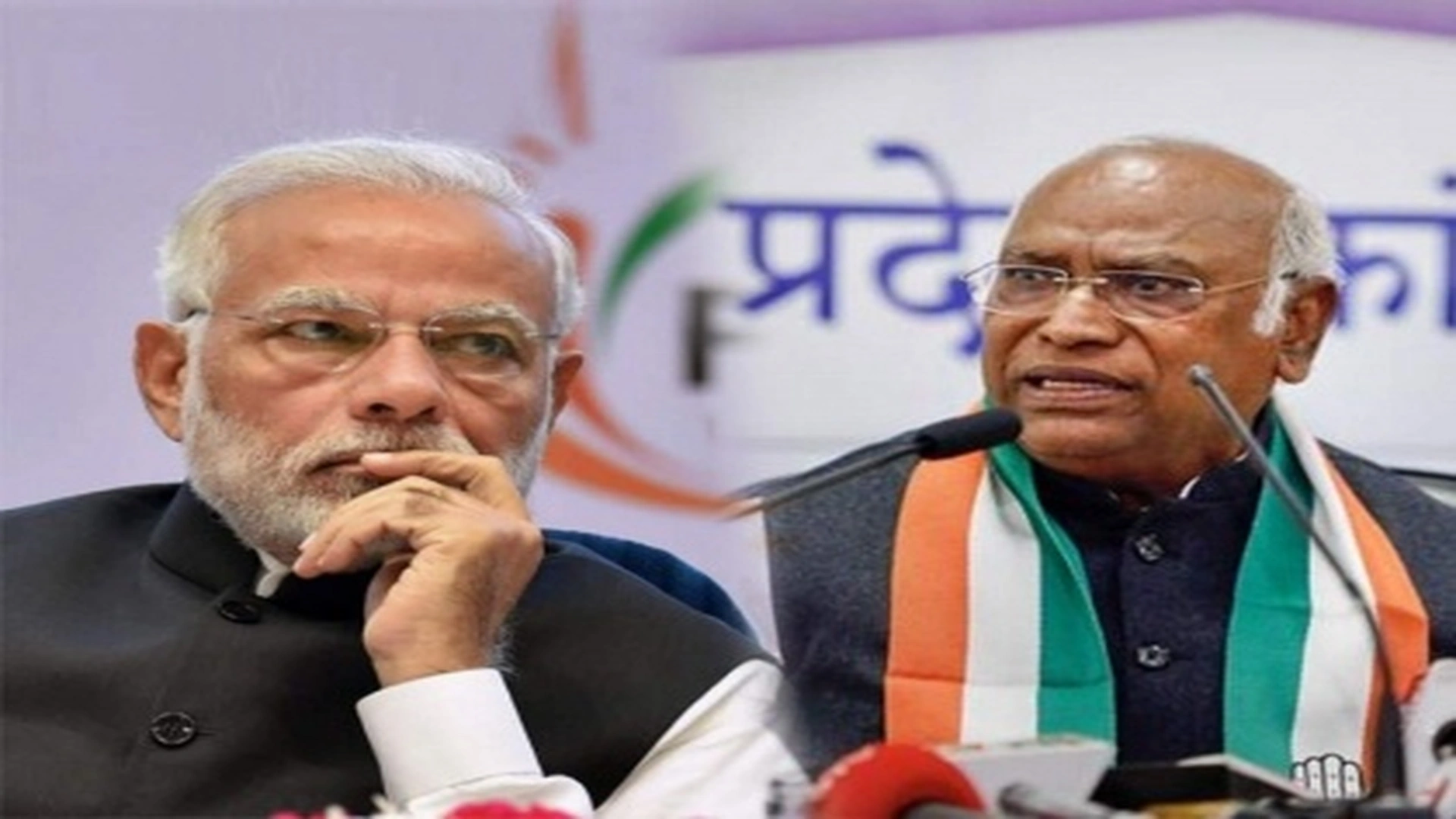
NEW DELHI: A sharp political confrontation unfolded on Saturday after Prime Minister Narendra Modi criticised opposition parties over the failure of the women’s reservation bill in the Lok Sabha, prompting a coordinated response from several opposition leaders led by Mallikarjun Kharge.
Kharge accused the Prime Minister of converting an official national address into a partisan political speech and claimed that the issue of women’s representation received far less attention than attacks on the opposition, particularly the Indian National Congress.
In a post on X, the Congress president said the Prime Minister mentioned Congress repeatedly while speaking only briefly about women, arguing that this reflected the government’s political priorities. He further alleged that the ruling Bharatiya Janata Party was more focused on blaming opponents than delivering meaningful reforms for women.
Kharge Questions Delay in Implementing Reservation Law
Kharge also raised questions over the delay in notifying the women’s reservation legislation passed in 2023. According to him, the Centre took nearly three years to issue the formal notification, despite projecting the law as a landmark reform.
He said the Congress had supported the legislation when it was introduced and remained committed to women’s political empowerment. He urged the government to implement 33 percent reservation for women within the existing strength of 543 Lok Sabha seats rather than linking it to wider constitutional changes and delimitation proposals.
Kharge also accused the government of confusing separate legislative issues by presenting delimitation related constitutional amendments alongside the women’s reservation debate. He alleged that the move was politically motivated and intended to redraw the electoral landscape in a manner favourable to the ruling party.
Mamata Banerjee Says Government Tried to Mislead the Nation
Mamata Banerjee also launched a strong attack on the Centre, saying the Prime Minister chose to mislead the country rather than address it honestly.
The All India Trinamool Congress chief said her party has consistently supported higher political representation for women and pointed to the share of women representatives elected by the party in Parliament and the West Bengal Assembly.
She said the party’s objection was not to women’s reservation but to the proposed delimitation exercise, which she alleged could alter the balance of federal representation. Banerjee claimed that redrawing constituencies in such a manner could disproportionately benefit some states while reducing the influence of others.
Calling it an assault on federal democracy, she said her party would continue opposing any move that undermines constitutional balance or regional representation.
Akhilesh Yadav Calls Defeat a Blow to BJP Strategy
Akhilesh Yadav described the bill’s defeat as a setback for the BJP rather than for women’s empowerment.
The Samajwadi Party leader said several measures introduced by the government were designed either to benefit select groups or to create political division. He argued that the latest legislative push had failed because opposition parties and sections of the public saw through its political intent.
His remarks reflected a broader opposition narrative that the government was using an important social issue for electoral messaging instead of building genuine consensus.
D K Shivakumar Raises Concerns Over Consultation and Representation
D. K. Shivakumar also criticised the timing and handling of the bill, saying opposition parties were not taken into confidence before the proposals were brought forward.
He stated that Congress has historically backed women’s reservation and reminded that the party had supported similar measures in the past, including expanded representation for women in local bodies.
However, Shivakumar said major constitutional changes affecting constituencies and representation required wider consultation. He warned that any redistribution of seats without consensus could deepen regional tensions, especially concerns in southern states about losing relative parliamentary influence.
He described the defeat of the bills as a democratic victory and said no government should attempt such sweeping electoral changes unilaterally.
PM Modi Calls Failure a Setback for Women
Earlier on Saturday, Prime Minister Modi said the failure of the women’s reservation bill was disappointing for women across the country. He apologised for not being able to secure its passage despite efforts by his government.
The remarks came a day after the government suffered a major setback in the Lok Sabha when the Constitution (131st Amendment) Bill failed to pass.
The proposal had sought to reserve 33 percent of seats for women in legislatures while simultaneously increasing the number of Lok Sabha seats from 543 to 816. The changes were intended to be implemented before the 2029 general election after a delimitation exercise based on the 2011 Census.
Why the Debate Has Become Politically Significant
The issue of women’s reservation has long enjoyed broad public support across party lines, but disagreement remains over how and when it should be implemented. While the government projected the latest proposal as a transformative reform, opposition parties argued that combining it with delimitation created avoidable controversy.
The debate has also exposed deeper tensions over population based seat redistribution, with some southern and eastern states expressing concern that states with slower population growth could lose influence in Parliament.
Political analysts say the controversy is likely to remain a major issue in national politics, especially as parties prepare for the 2029 general election.
Women’s Representation Remains the Central Question
Despite the heated political exchange, the core issue remains the underrepresentation of women in Indian legislatures. India has made gradual progress in recent years, but women still account for a minority of lawmakers in Parliament and many state assemblies.
Whether through immediate implementation under current seat numbers or through a future expanded framework, pressure is expected to grow on all parties to deliver a workable and credible roadmap.
For now, the collapse of the bill has triggered a new political battle, with both the government and opposition claiming to be the true defenders of women’s empowerment.